
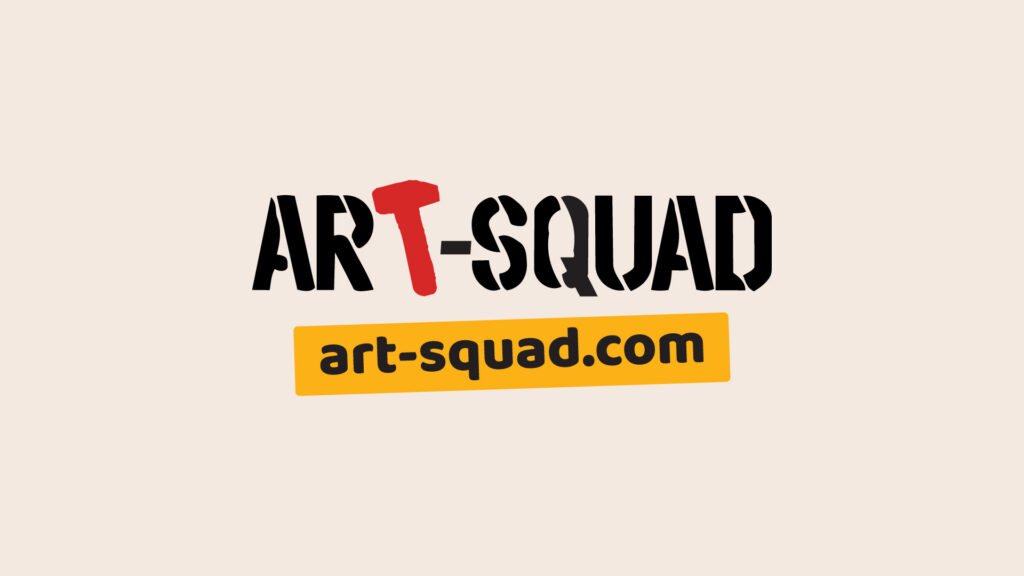
The art-squad logo: how it came about, and why there’s a hammer where the T should be.
We didn’t pick the hammer because it looked good in a wordmark. We picked it because it is, as far as we know, the oldest thing anyone ever made on purpose.
Older than us
In 2015 a team working at Lomekwi 3, on the western shore of Lake Turkana in Kenya, published something awkward. They had found stone tools dated to 3.3 million years ago — seven hundred thousand years older than anything found before, and older than the genus Homo itself. Among them: hammerstones, some weighing over three kilos, marked with the impact points of repeated, deliberate striking.
Read that again. The hammer predates us. We did not invent it. It was already there while we were still becoming what we are.
And what makes those stones remarkable isn’t that somebody hit something with them. Chimpanzees crack nuts with rocks. What makes them remarkable is that whoever used them had understood how stone breaks — and used that understanding to get a result they had in mind before they started. Intention, material, gesture. That’s the whole of making, three and a half million years ago, in one object.
The tool that makes tools
A hammerstone isn’t used on wood or meat. It’s used on other stones, to shape them into blades, scrapers, points. It is the tool whose only job is to bring other tools into existence — the first thing that was made in order to make.
Then 1920, then now
A few million years later the hammer picked up a second meaning. The Russian constructivists put it on posters, and it came to stand for labour — for the hand that shapes iron, for work as something worth being proud of rather than something to escape.
We inherit both. The hammer as the first creative gesture, and the hammer as the dignity of the people who work. Our manifesto puts them in the same line: from iron to synapses.
The designer hammering pixels at 3am is as much a worker as the blacksmith forging iron.
Which brings us to now. Machines can generate images. They cannot want one. The gap between those two verbs is exactly where we work, and the hammer is what marks it: the tool stays in the hand. Three million years of that, and we’re not handing it over in the last five.
Why it replaces a letter
The hammer doesn’t sit next to the name. It sits inside it, in place of the T — because the symbol and the word are not two things. Read it and you read ART. Look at it and you see the tool. You can’t separate them, which is the point.
It’s also the only red in the whole mark. Everything else is black, or cream on black. One colour, one object, one idea.
Cut, not typed
The letters are built like a stencil, with the small bridges that keep the inner shapes from falling out. That’s not a style we applied on top — it’s what a stencil requires. A mask with a floating island doesn’t work: the middle of the O drops away. So you leave bridges.
Look at those bridges for a second longer and they stop being a technical necessity. They’re connections. Things held together by what joins them. A hammer that forges synapses instead of iron, made out of the exact constraint that makes a stencil possible.
There’s a real one in the box
Every Art-Squad package contains an actual stencil, cut in reusable material. The logo is made like a mask, so the mask goes to whoever buys the piece. What you do with it is your business.
Every piece we make carries the name of the person who made it.